The Logbook Isn't a Title Deed: How Buyers End Up Paying Someone Else's Finance
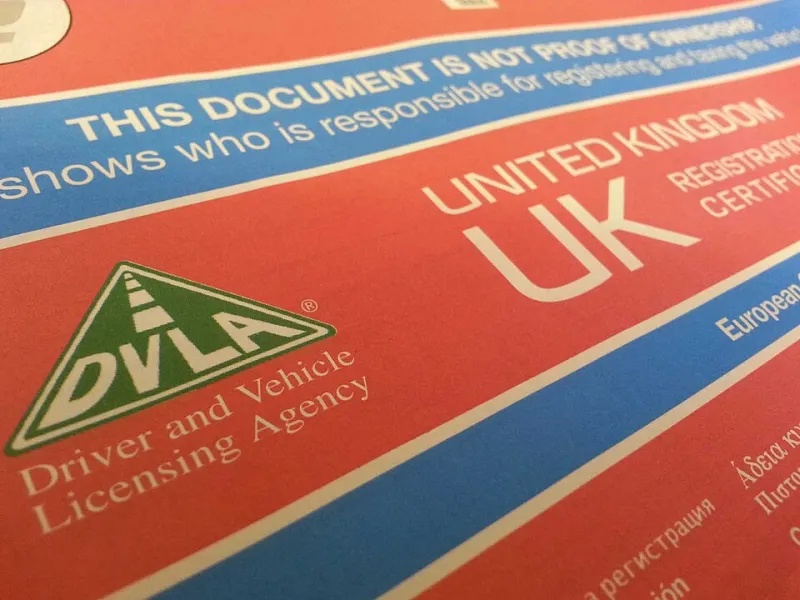
Photo: Davidrice557, CC0, via Wikimedia Commons
You can stand there with a V5C that looks fresh out of Swansea, matching the seller's name and address, and still drive away with a car that a finance company has a claim on. That is not a scare story. It is a paperwork gap, and it catches out private buyers and trade buyers alike.
The V5C is a useful document. It is just not the document most people think it is.
The V5C records a keeper, not an owner
The DVLA registers who is responsible for the car — the registered keeper. It does not record legal title, and it does not tell you whether someone has lent money against the vehicle. Those are two different questions, and the V5C answers neither of them properly.
That is why a seller can be the registered keeper while a lender still has a financial interest in the car. On paper, everything looks tidy. In reality, the debt can follow the vehicle.
For a workshop or trader buying stock, this matters twice over. You are protecting your own money, and you are protecting the customer who buys it from you. A finance claim that surfaces after a retail sale is not just an admin headache — it can freeze the car, drag your name through it, and turn a decent margin into a very expensive lesson.
Logbook loans: the debt that travels with the car
A logbook loan is secured against the vehicle, often under a bill of sale. The lender's security can stay attached to the car even when the keeper changes. The buyer inherits the problem, not the paperwork.
These are not always obvious from a standard glance at the V5C. The seller may genuinely believe they are up to date, or they may be hoping you will not ask. Either way, the car can be at risk if the loan is still live.
Ask directly: is there any loan, finance or bill of sale secured against this vehicle? Get the answer in writing, even if it is a text message. A seller who gets defensive about a simple question is giving you information.
Outstanding finance: a history check is step one, not the whole job
A proper HPI-style check is the starting point. It can flag outstanding finance, stolen markers, write-off records and plate changes. It is cheap relative to the size of the mistake.
But do not treat a clean report as a guarantee. Data can lag, and not every arrangement surfaces in the same way. Check the date on the report and make sure it is current for today, not last month. If finance does show up, do not accept a verbal promise that it will be settled. Get a settlement letter from the lender, or walk away.
For trade buyers, put the check on the buy-in sheet before you agree a price. A part-exchange that looks like a good deal can become a car you cannot retail cleanly. That is not margin — that is a hostage.
Cloned V5Cs: when the document itself is the lie
A cloned V5C is a copy built around another vehicle's identity. The details can look right because they belong to a real car. The document can look convincing because it is a decent copy of a real one.
Look at the physical document, not just the printed details. Check the serial number, the watermark, the print quality and the tear-off sections. Look for odd fonts, mismatched ink, or a serial that does not sit naturally with the rest of the document. Check that the VIN on the V5C matches the VIN plate on the car and the number stamped in the shell.
If the seller only has the green new keeper slip — the V5C/2 — that can be normal for a very recent sale, but the full V5C should follow. A seller who has 'never got round to it' is not automatically a crook, but it is a reason to slow down.
Three checks before the money moves
First, run a proper vehicle history check. Use a reputable service, read the whole report, and keep a copy. Do not rely on a screenshot from the seller.
Second, use the DVLA's online services to check tax and MOT status, and look at the MOT history. Match the vehicle details to the V5C. Confirm the VIN yourself rather than taking anyone's word for it.
Third, inspect the V5C and the seller's ID in person. Check the keeper name and address against a driving licence or recent utility bill. Look at the document's serial and watermark. If anything feels off, stop. There is no prize for being polite when a car has someone else's debt attached to it.
A clean logbook is a starting point, not a clean deal
The V5C tells you who the DVLA thinks is keeping the car. It does not tell you who owns it, who has a claim on it, or whether the document in your hand is genuine. Treat it as one piece of evidence, not a receipt for a clean transaction.
A few minutes with a history check, the DVLA site and a careful look at the paperwork is cheaper than a recovery letter landing on the mat. Whether you are buying for the forecourt or advising a customer, the rule is the same: verify the car and the debt before you verify the payment.